english spring project
what's on my mind?
what i have learned about literature
please click on the buttons below :)
Google Links
week 4
april 26 to april 30
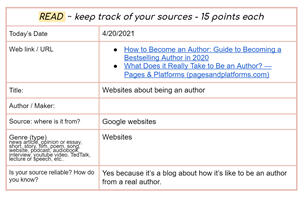
below are the things I learned about literature for assignment #3
please click on the buttons below :)
I wanted to annotate the readings but I haven't figured out how to highlight when I'm making the website.
'You're Welcome' from Moana (Disney Movie) is an example of a monologue.
WHAT IT TAKES TO BE AN AUTHOR
THE AUTHOR MINDSET
Willingness to claim the mantle. First and foremost, if you want to be an author, you have to take yourself seriously enough to actually call yourself a writer. If you say things like “I want to write someday,” you’ll keep thinking of that identity as belonging to your future self and never do what it takes to make it happen in the here and now. Even if you haven’t written so much as an email in the last five years, start calling yourself a writer today. Not an “aspiring writer,” a writer. Put “writer” in your Twitter profile. Introduce yourself that way at a party. The cognitive dissonance will make you crazy and put your ass in the writing chair so you won’t be a liar.
Persistence. Without tenacity, you’re never ever going to finish writing a book, much less build a platform that will sell it. As an author, you have to be absolutely committed to getting words on the page, then editing those words until they make enough sense and impact to change someone’s life.
Willingness to embrace rejection. As an author, you’re going to have to keep on putting yourself and your books out in the world, at risk of being ignored, rejected and humiliated. In fact, being ignored and rejected is pretty much guaranteed, even for the most successful authors. You have to be willing to take the bestseller list with the Twitter troll.
Patience. There are no overnight successes in this business. Books take months, more often years, to write and audiences take years to build. If you don’t have the patience to see the process through, pick a different vocation.
Trust in yourself. Ultimately, you as the writer have to make all the final calls. You decide when to scrap a book and when to ship it. As Kenny Rogers says: “You’ve got to know when to hold ‘em, know when to fold ‘em, know when to walk away, know when to run.”
THE AUTHOR SKILLSET
Doing the study. Good writing doesn’t just happen. Yes, lots of people have natural talent when it comes to cobbling words together, but talent only gets you so far. You have to read widely so you can learn the difference between the formulaic and the fresh, writing that works and writing that doesn’t, and stories that work and stories that don’t. And while good line writing is important, only amateurs ignore story structure. Structure is absolutely critical to writing a great book. (That’s why it’s the main thing our developmental editors focus on at Pages & Platforms.)
Putting down the words. You’ve got to develop the discipline it takes to get words on the page. I won’t pretend there’s a magic formula for what it takes to do this. Some people swear by sitting down for an hour every morning, or two hours every night after the kids go to bed, or weekend marathons. You have to find what works for you.
Accepting feedback. At some point, you’re going to have to share your manuscript with people who can help improve it. And, believe me, every manuscript a writer thinks is done can stand to be improved. You’ll have to ask for (and pay for) professional feedback and then be willing to revise, even if it means killing darlings and adding weeks or months of work.
Knowing the business. Whether you want to be traditionally published or set yourself up as an indie author, you need to understand the business of publishing. The days of being a writer who can just write and be insulated from business and marketing by an agent and a publisher are long gone. If you really want to be a successful author, you’re going to have to be informed about the industry and willing to jump into the marketing fray to get your book in the hands of its ideal reader.
week 2
april 12 to april 16
below are the things I learned about literature for assignment #2
please click on the buttons below :)
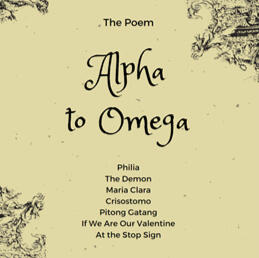
The Poem: the mini poster
BOOK TITLE:
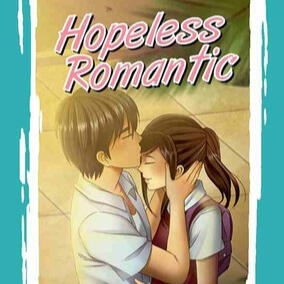
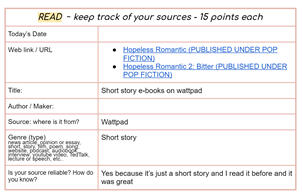
Hopeless Romantic (Short Story Book)
Story Summary
I've read the book a million times and I just can't get over the story. It gives me the ‘butterflies’ as they say. The author made me feel in love and being loved.
It was about a highschool boy who has a cold heart then he met a girl. It wasn’t easy for the both of them to fall in love with each other. It took them a while to realize their feelings. The story was just sooo sweet that ants were eating it (because ants love sweets). There were a lot of cute moments that got me into awe. Then they broke up… I’ve never talked to a book before but when the characters broke up I was crying out… Then there comes the climax. They got back together with some conflicts and thankfully at the end they solved it. They still got back together and broke up again… The story continued in another book which is part 2 or book 2.
Book Description
Rylie (one of the main character) has always believed in true love. Everyone is destined for happily-ever-afters, right? So despite having three boyfriends break her heart and her crush attempting to do the same, she holds steadfast and trusts that one day, her prince will come.
Then she meets snooty and arrogant Tyler. (one of the main character) Though he’s extremely hot, Rylie quickly forgets about him since he doesn’t seem to like her at all. But by some twist of fate, she gets involved in a plot to be Tyler’s pretend girlfriend to rid him of his psycho ex. Trouble comes knocking when she soon realizes that pretending to be in love isn’t really so distant from feeling the real thing... and Rylie has always been the girl who has a soft heart, one who easily falls in love. Will Tyler turn out to be the man of her dreams, or will he break her heart and prove once again that she’s just a sappy, hopeless romantic?
My DIARY
Dear Diary,
Today is Wednesday (4/21/2021) and I’m doing my assignment #2. I already started writing my own poem during the spring break but I think something feels off about it like something is missing but I’m still finalizing it sooo… Before I wrote the poem, I read and I listened to some poems and how people read it. Then I wrote it.. Just like that, I have a poem. I don’t want to judge it, I don’t want to judge it. But it’s too cheesy. Maybe because I wrote something about a feeling I’ve never felt before. I never really fell in love before but I’m in love right now with someone virtual. I wrote about him before. I wrote about feeling so depressed and then one day a boy came into my life and changed everything. Literally changed everything from the way I speak, act, and dress. The thing is.. I haven’t met this person before. Not in person, not in my dreams. I only saw him on my phone. He doesn’t know me but I know him. He changed my life, I changed his. We live on the opposite side of the world. When it’s day here, it’s night there. My mom knows the boy but she actually doesn’t know how he changed me. I want to write about him over and over again. I would have enough stories for him and about him. I want to write about him but I just want the thought to stay in my head and not write it. Is it too wrong?
Well afterall, I hope I can be a better writer for my english project. I don’t have any thoughts on being an author, it’s just that I want to write about something. It’s better on paper but everything now is virtual.
Love,
Bea <3
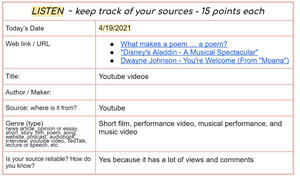
I watched these videos and I would say, I fell in love right away when I started watching the movies. So incredible! I want to watch Titanic too because it's kind of a love story. Love stories is the thing that I want to focus on since I'm writing my poem about love.
These are the videos that I want to connect my poem into
Some videos are short clips from movies, full movies, songs, and music videos
White Zombie Movie Clip
The Classic Love Story (Movie): Romeo and Juliet
Love Story by Taylor Swift
Mikrokosmos by BTS
Eight by IU
These are the books that I want to connect my poem into
Hopeless Romantic 1
Hopeless Romantic 2
PLAN: starT to write my poem
The idea is that the poem will have 7 parts (heptalogy)
The first two to three poems is about falling in love
The next two poems is going to be a transition poem where the love fades
The last poems is going to be about forgetting about that love
The poem will shift from the beginning to end of a temporary emotion
Another probable entry is about a place where you don't find any shadows and about the red shoes that dances
WHERE AM I NOW?
I'm finalizing the poem that I wrote during the spring break.
Below is the document where I'm writing my poem
WHAT I LEARNED ABOUT HOW TO WRITE A POEM/PROSE
11 Rules for Writing Good Poetry/Prose
(1) Read a lot of poetry. If you want to write poetry, start by reading poetry. You can do this in a casual way by letting the words of your favorite poems wash over you without necessarily digging for deeper meaning. Or you can delve into analysis. Dissect an allegory in a Robert Frost verse. Ponder the underlying meaning of an Edward Hirsch poem. Retrieving the symbolism in Emily Dickinson’s work. Do a line-by-line analysis of a William Shakespeare sonnet. Simply let the individual words of a Walt Whitman elegy flow with emotion.
(2) Listen to live poetry recitations. The experience of consuming poetry does not have to be an academic exercise in cataloging poetic devices like alliteration and metonymy. It can be musical—such as when you attend a poetry slam for the first time and hear the snappy consonants of a poem out loud. Many bookstores and coffeehouses have poetry readings, and these can be both fun and instructive for aspiring poets. By listening to the sounds of good poetry, you discover the beauty of its construction—the mix of stressed syllables and unstressed syllables, alliteration and assonance, a well placed internal rhyme, clever line breaks, and more. You’ll never think of the artform the same way once you hear good poems read aloud. (And if you ever get the chance to hear your own poem read aloud by someone else, seize the opportunity.)
(3) Start small. A short poem like a haiku or a simple rhyming poem might be more attainable than diving into a narrative epic. A simple rhyming poem can be a non-intimidating entryway to poetry writing. Don’t mistake quantity for quality; a pristine seven-line free verse poem is more impressive than a sloppy, rambling epic of blank verse iambic pentameter, even though it probably took far less time to compose.
(4) Don’t obsess over your first line. If you don’t feel you have exactly the right words to open your poem, don’t give up there. Keep writing and come back to the first line when you’re ready. The opening line is just one component of an overall piece of art. Don’t give it more outsized importance than it needs (which is a common mistake among first time poets).
(5) Embrace tools. If a thesaurus or a rhyming dictionary will help you complete a poem, use it. You’d be surprised how many professional writers also make use of these tools. Just be sure you understand the true meaning of the words you insert into your poem. Some synonyms listed in a thesaurus will deviate from the meaning you wish to convey.
(6) Enhance the poetic form with literary devices. Like any form of writing, poetry is enhanced by literary devices. Develop your poetry writing skills by inserting metaphor, allegory, synecdoche, metonymy, imagery, and other literary devices into your poems. This can be relatively easy in an unrhymed form like free verse and more challenging in poetic forms that have strict rules about meter and rhyme scheme.
(7) Try telling a story with your poem. Many of the ideas you might express in a novel, a short story, or an essay can come out in a poem. A narrative poem like “The Waste Land” by T.S. Eliot can be as long as a novella. “The Raven” by Edgar Allan Poe expresses just as much dread and menace as some horror movies. As with all forms of English language writing, communication is the name of the game in poetry, so if you want to tell short stories in your poems, embrace that instinct.
(8) Express big ideas. A lyric poem like “Banish Air from Air” by Emily Dickinson can express some of the same philosophical and political concepts you might articulate in an essay. Because good poetry is about precision of language, you can express a whole philosophy in very few words if you choose them carefully. Even seemingly light poetic forms like nursery rhymes or a silly rhyming limerick can communicate big, bold ideas. You just have to choose the right words.
(9) Paint with words. When a poet paints with words, they use word choice to figuratively “paint” concrete images in a reader’s mind. In the field of visual art, painting pictures of course refers to the act of representing people, objects, and scenery for viewers to behold with their own eyes. In creative writing, painting pictures also refers to producing a vivid picture of people, objects, and scenes, but the artist’s medium is the written word.
(10) Familiarize yourself with myriad forms of poetry. Each different form of poetry has its own requirements—rhyme scheme, number of lines, meter, subject matter, and more—that make them unique from other types of poems. Think of these structures as the poetic equivalent of the grammar rules that govern prose writing. Whether you’re writing a villanelle (a nineteen-line poem consisting of five tercets and a quatrain, with a highly specified internal rhyme scheme) or free verse poetry (which has no rules regarding length, meter, or rhyme scheme), it’s important to thrive within the boundaries of the type of poetry you’ve chosen. Even if you eventually compose all your work as one particular type of poem, versatility is still a valuable skill.
(11) Connect with other poets. Poets connect with one another via poetry readings and perhaps poetry writing classes. Poets in an artistic community often read each other’s work, recite their own poems aloud, and provide feedback on first drafts. Good poetry can take many forms, and through a community, you may encounter different forms that vary from the type of poem you typically write—but are just as artistically inspiring. Seek out a poetry group where you can hear different types of poetry, discuss the artform, jot down new ideas, and learn from the work of your peers. A supportive community can help you brainstorm ideas, influence your state of mind as an artist, and share poetry exercises that may have helped other members of the group produce great poetry.
Credits
website #1
still an on-going work
THE POEM
ALPHA TO OMEGA: A Heptalogy
Philia
When you passed by, what did I see?
I don’t know. I just felt it, I just knew it.
Your voice was like the whisper of a tree
In the morning when it’s so calm
And then I heard
The song of love
O love, can you hear?
How my heart beats, how your heart beats
Will I be able to eat tomorrow?
If it’s you that has been on my mind
Your charm in every day of my life
And even if you go away; it will never go away
My warmth is only for you
My love is kept only for you
O love, can you hear?
The beating of our hearts
The Demon
Did you know?
I wouldn’t have liked you
If you had an ugly personality
So dear, you don’t have to wonder
Why I fell in love with you
You are an angel who landed in hell
I’m the demon who will guide you back to heaven
While we were flying
I fell in love with you
What if you suddenly be gone
When you give colors to my heart and feelings
You are the princess that landed far away
I am the slave that will guide you
Back to the palace
As we run on our way
I fell in love with you
Maria Clara (Crisostomo’s POV)
Your hair thins out like the night
As the break of dawn gives hue to the heavens
Your smile is a star burning for ages
Only to die, leaving its glowing remnants
Only now that I have seen when it is gone
Your life is likened to a candle
That banishes the darkness of the night
With its bad omens and sorrowful screams
Like a candle, you lose yourself each second
Candle wax falling like your crystal tears
Hazily forming themselves like white butterflies
Not even once did I swallow a butterfly
Yet my stomach feels a thousand of them inside
Until I realized, the first moment I uttered your name
One butterfly flew into my mouth,
And perhaps…
When will the sorrow burned beneath your smiles be found?
Yet even when you fade away; it will never go away
This feelings will always live on
For my heart and soul is always yours
Crisostomo (Maria Clara’s POV)
Every smile
Every teardrops
Every blink
Every breath we take in
Every exhale
And while you're being embraced tight
I whisper a prayer; that this won't be taken by the wind
O, the warmth of your skin and every thread of your hair
The light is passing through the pockets, coming to me
Every piece that makes you up
Every piece that I wish were mine
All my life
Don't let go
Don't disappear
O, I carry every piece of you
What would I do without you?
Without you?
Stay here for all my life
All my life
Mary Claire and Chris
Sitting, staring into space
Alone with the cicadas outside
Perhaps, maybe, I will be heard
Remembering the day
Always so brilliant, scintillating, brightening
Sort of like me whenever I see you; my light in the dark
And when you hugged me
It seems like all the problems in this world full of greed and filth disappeared
Eyes slowly becoming clearer
Don’t let go yet, my love
I can’t shine without you
Lonely and sad are the nights
So cold and chilly without your warmth
There would be no color in the streets
There would be no life in this world
If you’re not by my side
“Crisostomo, my love,
My name’s Clara
Are we fated by the universe?”
Yet, we have been separated
Blushing red
Whenever we face each other
While I hold your hand
I will cherish this moment
And when you sang to me
It’s like time stopped
Just before the New Year comes
Reading your letters
While I wear the necklace you gave
To make a way to bring back the past
Can we go back to the past?
Or how about we move forward together?
I will continue loving you, even if you don’t want my love anymore
I will continue loving you, I will love you for all of my life
I will continue loving you, that is it and nothing else
Do you still remember the days that were so sweet
As long as we were together
Our smiles would reach the farthest star
“How are you?”
It’s really exhausting
“Are you okay?”
I think you’re tired
Of the toxicity of people
Or perhaps, maybe, of me
Even so, I’ll stay by your side
If We Are Our Valentine
You’re crying again
Because of a worthless reason
What happened to the two of us?
We just always don’t get along
Let's talk about this
This is too chaotic
I still love you
But it seems ambiguous
Maybe we need time
To think about all this
We’re screaming again
For no good reason
How did we get here?
In just a moment we might hurt each other
If we really are for each other
Fate will tell us
Whether to let go or not
If you are for me
Even if we are still apart
The heart will find its way back to you
It’s enough
Because if we really are for each other
We really are
At the Stop Sign
I’m going to forget about you now
Make sure that we can’t truly be together
Have you thought about it?
Because I’m going to forget about you now
Wait until it goes
I’m also going to forget about the things you said
That had no meaning after all
As well as your smile and the tears you cry as you sigh
Wait until it goes
Finally erasing from the mind
The shape of your eyes as you laugh
The way you dress and how you take a short nap
Wait until it goes
Is it really a goodbye?
If we don’t see each other again
Make it so that the hands of God will pull us
For one encounter in a vision
I’m going to forget about you now
Make sure that we can’t truly be together
Have you thought about it?
Because I’m going to forget about you now
Here it goes
~END~
week 1
april 5 to april 9
below are the things I learned about literature for assignment #1
please click on the buttons below :)
CREDITS
website #1 ~ website #2
what i learned about poems
What is a poem?
a piece of writing that partakes of the nature of both speech and song that is nearly always rhythmical, usually metaphorical, and often exhibits such formal elements as meter, rhyme, and stanzaic structure.
Types of Poem
Haiku – A type of Japanese poem
Free Verse – Consists of non–rhyming lines
Epic – A form of lengthy poem, action of historical significance, or a great mythic.
Ballad – A type of narrative poem in a form of a moral lesson or a song
Sonnet – It is a form of lyrical poem
Elegy – A melancholic poem
Epitaph – A small poem
Hymn – This type of a poem praises spirituality or God’s splendor.
Limerick – This is a type of humorous poem
Villanelle – A French styled poem
Examples of Poem in Literature
Haiku Poem
“While you decline to cry,
high on the mountainside
a single stalk of plume grass wilts.”
Epic Poem
“By the shore of Gitchie Gumee,
By the shining Big-Sea-Water,
At the doorway of his wigwam,
In the pleasant Summer morning,
Hiawatha stood and waited…”
Free Verse Poem
“After the Sea-Ship—after the whistling winds;
After the white-gray sails, taut to their spars and ropes,
Below, a myriad, myriad waves, hastening, lifting up their necks,
Tending in ceaseless
flow toward the track of the ship:
Waves of the ocean, bubbling and gurgling, blithely prying…”
Ballad
“O what can ail thee, knight-at-arms,
Alone and palely loitering?
The sedge has wither’d from the lake,
And no birds sing …
And this is why I sojourn here
Alone and palely loitering,
Though the sedge is wither’d from the lake,
And no birds sing.”
WHAT I LEARNED ABOUT PROSE
What is a prose?
Prose is verbal or written language that follows the natural flow of speech. It is the most common form of writing, used in both fiction and non-fiction. Prose comes from the Latin “prosa oratio,” meaning “straightforward.”
4 Common Types of Prose
Nonfictional prose Prose that is a true story or factual account of events or information is nonfiction. Textbooks, newspaper articles, and instruction manuals all fall into this category.
Fictional prose A literary work of fiction. This is the most popular type of literary prose, used in novels and short stories, and generally has characters, plot, setting, and dialogue.
Heroic prose A literary work that is either written down or preserved through oral tradition, but is meant to be recited. Heroic prose is usually a legend or fable.
Prose poetry Poetry written in prose form. This literary hybrid can sometimes have rhythmic and rhyming patterns.
Examples of Prose in Literature
“All the world’s a stage, And all the men and women merely players."
As You Like It (By William Shakespeare)
“It was a bright cold day in April, and the clocks were striking thirteen.” 1984 (By George Orwell)
“Whether I shall turn out to be the hero of my own life, or whether that station will be held by anybody else, these pages must show.”
David Copperfield (By Charles Dickens)
“Happy families are all alike; every unhappy family is unhappy in its own way.”
Anna Karenina (By Leo Tolstoy)
“You can be young without money, but you can’t be old without it.”
Cat on a Hot Tin Roof (By Tennessee Williams)
WHAT I LEARNED ABOUT MONOLOGUES
What is a monologue?
Monologue is a literary device that is the speech or verbal presentation given by a single character in order to express his or her collection of thoughts and ideas aloud. Often such a character speaks directly to audience, or to another character. Monologues are found in dramatic medium like films and plays, and also in non-dramatic medium like poetry.
Types of Monologue
Interior Monologue
In interior monologue, a character externalizes his thoughts, so that the audience can experience his internal thoughts. Internal monologue can bebroken further into two categories: direct and indirect. In a direct interior monologue, an author does not show his presence, and directly reveals his character. In an indirect interior monologue, an author appears as a commentator, guide, presenter, and selector.
Dramatic Monologue
In this type of monologue, a character speaks to the silent listener. This type has theatrical qualities, hence, it is known as dramatic monologue, and is frequently used in poetry.
Difference Between a Monologue and a Soliloquy
Monologue and soliloquy are similar, as both are speeches presented by a single person. But a major difference between them is that, in monologue, the speaker reveals his thoughts to the audience, or to any other character; whereas in a soliloquy, the speaker expresses his thoughts to himself, and it does not involve any other characters.
Examples of Monologue in Literature
“But soft, what light through yonder window breaks?
It is the east and Juliet is the sun!
Arise, fair sun, and kill the envious moon,
Who is already sick and pale with grief …
O that I were a glove upon that hand,
That I might touch that cheek!”
Romeo and Juliet (By William Shakespeare)
“And indeed there will be time
To wonder, ‘Do I dare?’ and, ‘Do I dare?’
Time to turn back and descend the stair,
With a bald spot in the middle of my hair …
In a minute there is time
For decisions and revisions which a minute will reverse.'”
The Love Song of J. Alfred Prufrock (By T. S. Eliot)
“Even had you skill
In speech—(which I have not)—to make your will
Quite clear to such an one, and say, ‘Just this
Or that in you disgusts me; here you miss,
Or there exceed the mark’ — and if she let
Herself be lessoned so, nor plainly set
Her wits to yours, forsooth, and made excuse,
—E’en then would be some stooping …”
My Last Duchess (By Robert Browning)
MONOLOGUES I LISTENED TO
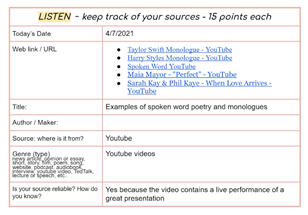
Taylor Swift's Monologue
Harry Style's Monologue
WHAT I LEARNED ABOUT SPOKEN WORD POETRY
What is a spoken word poetry?
A broad designation for poetry intended for performance. Though some spoken word poetry may also be published on the page, the genre has its roots in oral traditions and performance. Spoken word can encompass or contain elements of rap, hip-hop, storytelling, theater, and jazz, rock, blues, and folk music. Characterized by rhyme, repetition, improvisation, and word play, spoken word poems frequently refer to issues of social justice, politics, race, and community.
Examples of Spoken Word in Literature
“And I’m gonna love her till she loses every last root and has to glue dentures to her gums to chew solid food. Ooo, now that’s real love dude. That’s some push comes to shove love. Not when it’s convenient, love. Hospital bed, love. Feed her ice chips, love. Never leave the room, love. Sleeping in the chair, love. Pray to up above, love. Have to pull the plug.”
IN-Q (USA), The Only Reason We’re Alive
“I make them realize that if you’ve got… this 🧠 then you follow… this 🖤 And if anyone tries to judge you based on what you make, you give them this 🖕 Here, let me break it down for you, so you know what I say is true. Teachers, make a goddamn difference. Now what about… you?”
Taylor Mali (USA), What Teachers Make
“I love the beach. And I love swimming in the sea. I love having adventures because I love feeling free. I love people who are up for stuff, and spontaneity. The truth is, I love life. I love people who love life like me. Sometimes, it’s for the glory. Sometimes, it’s for the story. Mostly it’s because I believe we weren’t made to be ordinary.”
Harry Baker (England), Western Super Nightmare
SPOKEN WORD POETRY I HAD LISTENED TO
Explaining My Depression to My Mother
Perfect
When Love Arrives
Assignment #1
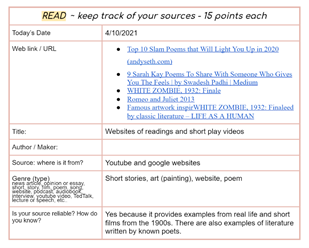
Assignment #2
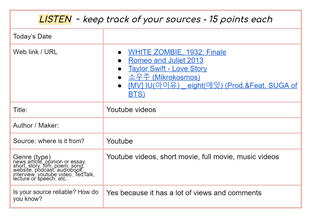
Assignment #3